
A bill reintroduced in Congress aims to limit the authority of the Consumer Financial Protection Bureau (CFPB) over insurance-related activities, drawing backing from several major insurance trade groups.
The Business of Insurance Regulatory Reform Act seeks to prevent the CFPB from applying its regulations to entities that are already subject to oversight by state insurance regulators.
According to the bill text, this prohibition applies even if those entities provide a consumer financial product or service, provided they are engaged in the business of insurance.
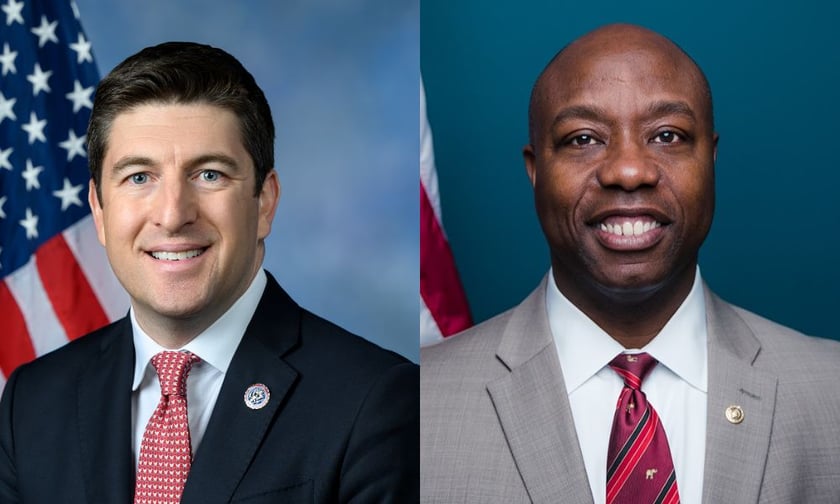
Rep. Bryan Steil (R-Wis.) (pictured above, left), who introduced the bill in the House, said the legislation reinforces congressional intent to keep insurance matters outside the CFPB’s jurisdiction.
"Unfortunately, the CFPB has tried to expand its authority without any accountability. It's time for the bureau to return to the boundaries set by Congress and this bill is a step forward in making sure it does,” Steil said.
Sen. Tim Scott (R-S.C.) (pictured above, right) introduced the bill in the Senate.
The bill follows concerns that ambiguity in the Dodd-Frank Act’s language has allowed the CFPB to interpret its authority more broadly than intended. While Title X of the law explicitly excludes the “business of insurance” from the CFPB’s oversight, and shields any entity regulated by a state insurance commissioner, supporters of the legislation argue that these provisions have not sufficiently curtailed the bureau’s actions in practice.
The legislation also aligns with the longstanding principles of the McCarran-Ferguson Act of 1945, which gives states the primary role in regulating the business of insurance. That statute has served as the foundation for the state-based regulatory system, reinforcing the view that federal agencies should not intrude unless Congress explicitly authorizes such action.
Several national insurance associations – including those representing property/casualty, life, title insurers, and insurance agents – voiced support for the measure. They maintained that oversight of the insurance sector should remain with state regulators, citing their existing consumer protection frameworks.
American Council of Life Insurers President and CEO David Chavern said the legislation acknowledges the oversight capabilities of state regulators, including during periods of instability such as war or economic downturns.
The proposal mirrors a prior version of the bill introduced during the 2017–2018 legislative session. That earlier attempt was reported favorably out of committee but ultimately did not progress to a full vote in either chamber.
Sen. Joe Manchin (D-W.Va.) has also voiced support for the current bill, framing it as a bipartisan effort to ensure the CFPB adheres to its original scope. He emphasized the need to protect the role of state regulators while reaffirming the limitations Congress placed on the bureau when it was created.
In a joint letter to Steil and Scott, the supporting trade groups argued that revisions to the Dodd-Frank Act are necessary to reaffirm the law’s exemptions for insurance and to define the CFPB’s limits.
"By further clarifying the limits of CFPB's regulatory authority and affirming the presumption of exclusive authority of a state insurance regulator, this key legislation will create certainty for insurers, agents and consumers that there will not be duplicative or conflicting consumer protection regulations in the future," the letter said.
The letter was signed by the ACLI, the National Association of Mutual Insurance Companies, the American Property Casualty Insurance Association, the National Association of Professional Insurance Agents, and the Independent Insurance Agents and Brokers of America.
What are your thoughts on this story? Please feel free to share your comments below.





