
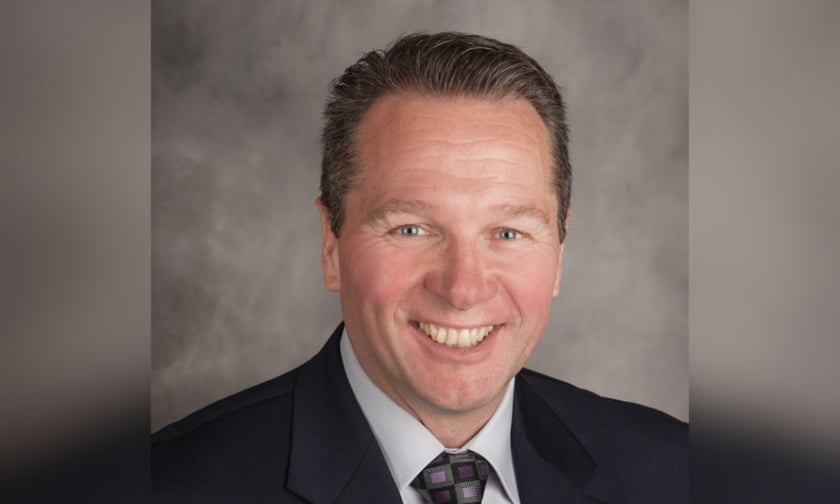
Rising seas and stronger storms have pushed commercial property insurers into a defensive posture. From Connecticut to northern Maine, coastal risk is no longer a hypothetical – it’s a pricing factor. Tony O’Donnell (pictured), senior vice president and commercial lines producer at Jencap, said the shift is visible in every policy term.
“You might be looking at a 3% to 5% wind deductible,” he said, referencing properties located on exposed barrier islands. “Or it could be something that’s on the coastline and sheltered, which may be a 1% or a 2% wind deductible.”
Deductible structures have grown more aggressive. Policies now often split standard windstorm deductibles from named storm deductibles, with the latter sometimes doubling. “We want a 2% wind, but we might want a 5% named storm deductible, depending on where the risk is exposed,” said O’Donnell.
Beyond wind, flood zones have crept inland following updates to FEMA’s risk models. “Properties that were previously not in a flood zone sometimes find themselves into a flood zone,” said O’Donnell. That reclassification drives new requirements – either mandatory NFIP participation or private flood coverage. “Depending on their elevation or their location in an estuary or close to the ocean,” properties may now face compulsory protection, he added.
Hail-related losses, once a minor concern in the Northeast, have also crept onto carriers’ radar. Some are adding cosmetic damage exclusions tied to convective storms. “Back 30 years ago, it wasn’t really prevalent,” he said, but convective storm damage is now a common policy feature.
Winter is also exerting its influence on pricing. As Nor’easters dump heavy snow across New England, the risk of ice damming has multiplied. “You get ice dam buildups, water then backs up behind those ice dams, and then you get water damage inside both your residential and commercial buildings,” O’Donnell said. One incident can trigger multi-unit losses, prompting underwriters to adopt per-unit water damage deductibles atop standard all-other-perils terms.
As standard carriers like Travelers and Hartford withdraw from certain coastal risks, brokers such as Jencap step in. “If they exit the space, then it creates a vacuum,” said O’Donnell. “We can write property on the coast, albeit with a higher wind deductible... or more restrictive coverages.” That capacity often comes from partner companies or Lloyd’s facilities.
Replacement cost expectations are also tightening. Insurers have raised baseline valuations to reflect true rebuild costs, especially in remote or island locations. “Inland, it might be $200 a square foot,” O’Donnell said. “Whereas on the island, it might be $800 a square foot.” That disparity reflects not just materials and labor, but the logistics of delivery and repair following catastrophic loss.
After two years of reduced capacity and climbing prices, O’Donnell said the market has shown signs of stabilizing. “We’re seeing a moderation of prices now,” he said. “There is increased capacity coming into the market.”
With solvency concerns mounting in parts of the industry, Jencap makes every effort to exclusively leverage A-rated carriers or better. “My team makes sure that our trading partners are at least A-rated or better,” O’Donnell said. “We don’t want to place business with carriers that have a suspect rating.” Long-standing relationships also play a role, he added, with some dating back 30 years.
Client behavior is also shifting. Faced with rising premiums, many are opting to absorb more of the risk. “Maybe I will retain a little bit more of the risk to keep the premium levels down,” said O’Donnell. That can mean higher deductibles or coverage exclusions, provided they don’t violate mortgage requirements.
“Fannie Mae and Freddie Mac... put restrictions on mortgage loans,” he said. “A water damage deductible cannot exceed a certain threshold of the total insurable value.”
He also pointed to deductible buyback programs as a tactical option. “Instead of a 5% wind deductible, it’s now only down to 1% because you added a few extra thousand to the policy,” said O’Donnell. These endorsements can be placed with the same or a separate carrier to help maintain coverage flexibility.
Clients are also beginning to request coverage for nontraditional climate impacts. “You now get insurance requests for weather cancelation events,” said O’Donnell, describing demand from organizers of outdoor weddings and concerts. Some condominium boards are buying snow overage insurance - protection for when seasonal snowfall exceeds budgeted removal costs. “If their average is 60 inches a year and it snows 120 inches, they can actually buy insurance to protect them from the difference,” he said.
That shift shows the evolving definition of climate risk in commercial insurance. It’s no longer confined to hurricanes or floods - it now includes the operational and financial fallout from any weather-driven disruption. For wholesalers like Jencap, that means helping clients navigate not just exclusions and deductibles, but entirely new classes of protection.





