
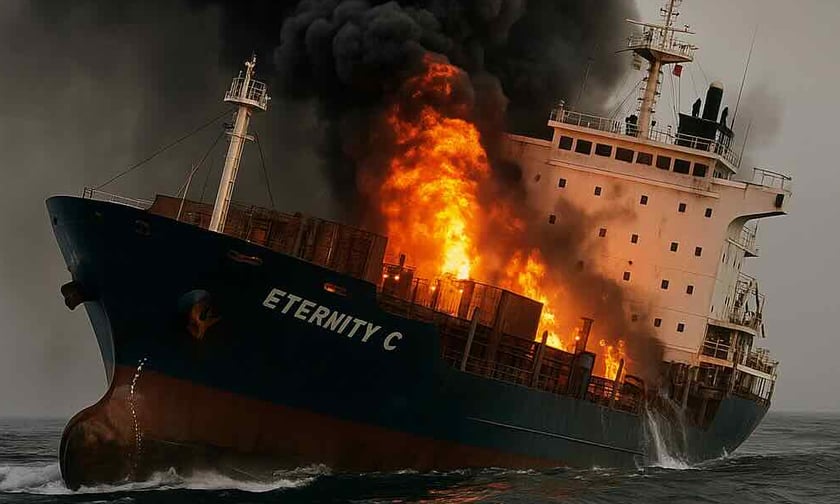
Insurance costs for vessels transiting the Red Sea have spiked sharply in response to a fresh wave of attacks by Houthi militants, highlighting growing volatility in one of the world’s most vital maritime trade corridors.
Over the past week, two cargo ships – the Magic Seas and Eternity C – were attacked and sunk by the Yemen-based group, leaving at least four crew members dead and several others unaccounted for. The violence has sent war risk premiums for vessels operating in the region soaring, with marine insurers rapidly reassessing exposure and, in some cases, suspending coverage altogether.
According to sources at several insurance brokers and underwriters, rates have climbed from 0.3% to as high as 1% of a vessel’s insured value – levels not seen since the height of last year’s attacks. A seven-day voyage through the high-risk area could now incur costs upwards of $1 million for a $100 million vessel, up from roughly $300,000 prior to this latest escalation.
“This is one of the most abrupt surges we’ve witnessed in recent memory,” Marcus Baker, global head of marine and cargo at Marsh McLennan told the UK’s Financial Times. “The speed and severity of the change in risk profile has prompted shipowners and their insurers to reevaluate whether the corridor remains viable at all”.
The Magic Seas, a Liberian-flagged dry bulk carrier owned by Greece’s Stem Shipping, was attacked on Sunday. The Houthis claimed responsibility and released footage of militants boarding the ship and triggering explosions that ultimately sank the vessel. All 22 crew members were rescued by a passing merchant ship.
Less than 48 hours later, another Greek-operated cargo ship, the Eternity C, was struck by rocket-propelled grenades and maritime drones, killing at least four crew members, injuring others, and prompting a wide-scale search-and-rescue operation. The group also claimed to have taken some surviving crew members into “custody”.
The US embassy in Yemen has accused the Houthis of “kidnapping” sailors from the Eternity C and demanded their release. The Philippines, which confirmed that 21 of the vessel’s 25 crew were Filipino nationals, has also called for international assistance in securing their safe return.
While the Houthis allege their actions are aimed at vessels connected to Israel, Western officials and shipping analysts say the targeting criteria are ambiguous and fluid, creating major uncertainty for the global marine insurance market.
“Even vessels with only indirect or historic links to Israeli ports or companies may now be considered at risk,” Munro Anderson, head of operations at Vessel Protect told the BBC. “Ambiguity, in this environment, is itself a risk multiplier.”
With violence escalating, underwriters are reassessing their risk appetite. Some Lloyd’s syndicates are said to have paused binding authority in the region altogether, while others are only providing quotes with significantly restricted terms or elevated deductibles.
Industry sources suggest that even major hull and war markets that typically maintain capacity for high-risk regions are now approaching Red Sea exposures more cautiously. “There has been a realignment of views across markets,” one senior London underwriter said. “Capacity is still available, but only at a steep price.”
Marcus Baker of Marsh noted that the attacks represent a “very quick escalation,” and warned that if vessels continue using the Red Sea corridor, premiums are likely to rise further.
The increase in premiums also raises broader concerns about trade costs and supply chain pressures. The Red Sea remains a strategic artery for global oil and commodity shipments, and any prolonged disruption or rerouting around the Cape of Good Hope could lead to delays, price inflation, and further complexity for global cargo underwriters.
The resumption of Houthi attacks follows a fragile ceasefire agreement reached with the United States in May, intended to pause strikes in exchange for reduced hostilities. However, the Houthis have made clear that their campaign against Israeli-linked vessels is ongoing, a stance reinforced by recent attacks and statements posted online.
The International Maritime Organization (IMO) condemned the attacks and called for renewed diplomatic efforts. “Innocent seafarers and local populations are the main victims of these attacks and the pollution they cause,” said IMO Secretary-General Arsenio Dominguez.
Israel has responded militarily, striking several ports and facilities in Yemen, including Hodeidah and Ras Isa, after the latest incidents.
For the insurance sector, the situation represents a live test of war risk modelling and portfolio resilience. Several brokers are preparing for potential claims stemming from the latest incidents, although the extent of insured losses remains unclear.
Marine insurers, particularly those involved in high-value hull, cargo and war risks, are watching the situation closely. The concern is not just the frequency of attacks, but the increased lethality and the group’s continued ability to operate despite military pressure.
As markets adjust, the implications are being felt across the reinsurance chain as well. With major placements coming due for renewal later this quarter, brokers anticipate a challenging round of negotiations for accounts with Middle East exposure.
The Houthi threat may have been temporarily dormant, but for the global insurance market, its return has reignited a costly and complex front in maritime underwriting.
|
Insurer |
Headquarters |
Key Strengths |
|
Germany |
Global leader in hull, cargo, and liability; Lloyd’s Syndicate 1686 |
|
|
AXA XL |
France / US |
Strong in blue water marine; Lloyd’s Syndicate 2003 |
|
Germany |
Top global reinsurer with large marine reinsurance portfolio |
|
|
Switzerland |
Major treaty reinsurer; advanced modelling capabilities |
|
|
Tokio Marine HCC |
Japan / US |
Specialty underwriter; Lloyd’s Syndicate 4141 |
|
Sompo International |
Bermuda / Japan |
Rapid global growth; Asia-Pacific and US cargo |
|
US |
Leading cargo and marine liability provider |
|
|
Liberty Specialty Markets |
US / UK |
Lloyd’s Syndicate 4472; strong in hull and energy-linked risks |
|
UK |
Specialist in marine cyber and liability risks |
|
|
RSA Insurance (Intact Financial) |
Canada / UK |
Legacy European cargo and transit strength |





