

This article was created in partnership with QBE.
by Jaini Gudhka, Senior Risk Manager, QBE Europe
For businesses, Generative Artificial Intelligence (GenAI) is both exciting and daunting. Users of GenAI reached around 77 million in the two years following the November 2022 release of ChatGPT – which is more than double the rate of uptake for mobile phones at the height of their user adoption.
Undoubtedly, GenAI can give a competitive edge, by speeding up operations for instance. But this fast-evolving technology poses new risks to data privacy, intellectual property or sound decision making. While businesses are increasingly looking to engage with the new opportunities that AI offers, many are simultaneously grappling to understand and manage the full risk landscape that it operates within.
Research from Riskonnect revealed that although 93% of surveyed companies were aware of AI-related dangers, only 17% have briefed their workforce or implemented any training – and only 9% said that their organization was prepared for these risks.
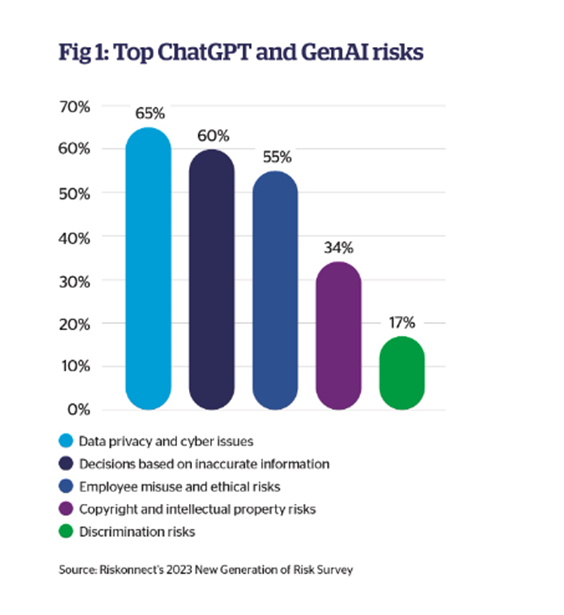
While uncertainty around AI might lead some to try a ‘wait and see’ approach, risk managers should examine how GenAI applications are being applied to internal and external business operations in more detail. Short- and long-term planning should combine a robust risk management framework alongside structured scenario testing to address potential dangers.
For entrepreneurs who want to experiment with GenAI in a safe way, we have compiled a seven-point checklist to mitigate those risks:
Many AI tools will capture the data input for their own machine-learning processes. Make sure the one you select meets client confidentiality and information security standards. The National Cyber Security Centre provides some guidelines for secure AI system development.
Include data and cyber requirements in the Service Level Agreement and consider contractual protections if your own service delivery model will rely on output from an AI tool.
When selecting third-party providers who will have access to your and your clients’ data, check their AI safeguards.
Keep a record of what data you have, its quality, value, and where it is stored.
You should include a detailed data strategy in your AI risk management plan, and use a diversity of sources to mitigate the risks of bias.
Purchasing a cyber insurance policy not only helps businesses transfer emerging risks. It gives them access to a range of associated services and expert advice to better protect themselves and, in case of an incident, recover more quickly.
By taking these reasonable steps, businesses should feel confident enough to experiment with GenAI, rolling out the innovations that are right for them and their clients.



