
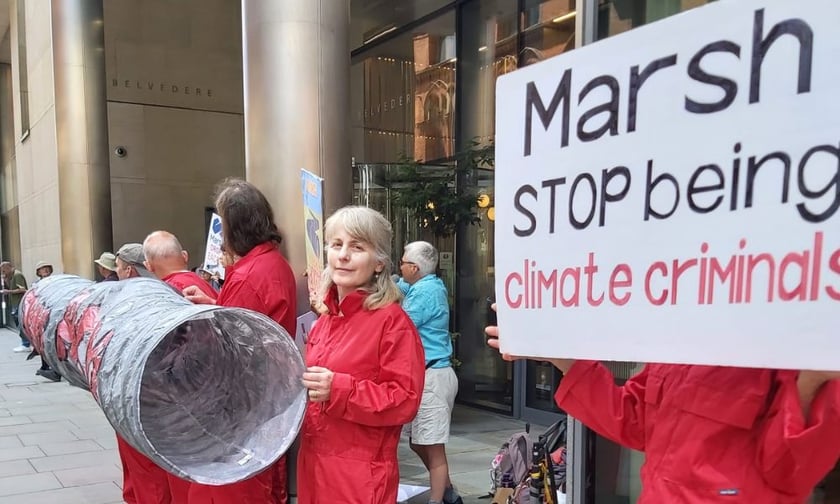
Global brokerage Marsh found itself in the crosshairs of climate activists with protests focused on the insurance industry’s role in underwriting fossil fuel projects.
The demonstration outside of Marsh’s Manchester offices, led by supporters of Extinction Rebellion’s Insure Our Survival campaign, was part of a coordinated week of action taking place across the UK.
More than a dozen protesters assembled outside Marsh’s premises in Belvedere, Booth Street, distributing materials and reading testimonies from individuals in Uganda said to be affected by the East African Crude Oil Pipeline (EACOP).
The group urged Marsh employees to support calls for the broker to withdraw from the project, which has drawn criticism from campaigners over environmental and human rights concerns.
EACOP is a proposed 1,443km pipeline that would transport crude oil from Uganda to the Tanzanian coast. The project has been linked to the displacement of communities and risks to water and food security in the region. Opponents of the pipeline have also pointed to its potential environmental impact on areas such as Lake Victoria and Murchison Falls National Park.
Marsh McLennan secured the contract to arrange insurance for EACOP in March 2022. The broker has since faced repeated calls to end its involvement in the project, including sustained pressure from environmental and human rights groups.
In 2023, internal dissent emerged at Marsh over the company’s connection to EACOP. More than 100 employees reportedly signed a letter urging senior management to end broking services for the project, citing its potential for severe environmental and social harm.
Later that year, the firm was named in a formal complaint submitted to the OECD by Inclusive Development International and other advocacy organisations. The complaint alleged that Marsh’s involvement in the pipeline project constituted a breach of OECD guidelines relating to human rights and environmental protections.
Marsh is reported to have been involved in providing insurance broking services for a number of major fossil fuel projects in addition to EACOP. These include the Banshkhali coal hub in Bangladesh, the Carmichael coal and rail project in Australia, the Trans Mountain Pipeline in Canada, and liquefied natural gas terminals in the US Gulf Coast.
According to campaigners, the EACOP has become a key target for insurers withdrawing from high-emission projects. As of September 2023, 22 insurance companies had made public commitments not to provide cover for the pipeline.
Protest activity against insurance support for fossil fuels has not been limited to Marsh. Advocacy groups have staged demonstrations at the offices of multiple insurers, calling on the wider market to halt support for developments such as EACOP.
In response, some major insurers have recently revised their approach to high-emissions projects. Chubb, which also has offices on Booth Street, stated earlier this year that it would not provide coverage for EACOP.
Martin Porter of Manchester Greenpeace said oil should be left underground and questioned the role of financial intermediaries in facilitating extraction projects.
“We are already seeing the catastrophic effects of climate chaos on our TV screens. Instead of displacing poor people to pipe oil across Africa so that Big Oil can make even more money, we should be leaving it in the ground. Our message is simple: oil companies need to stop drilling and start paying,” Porter said.
What are your thoughts on this story? Please feel free to share your comments below.



