
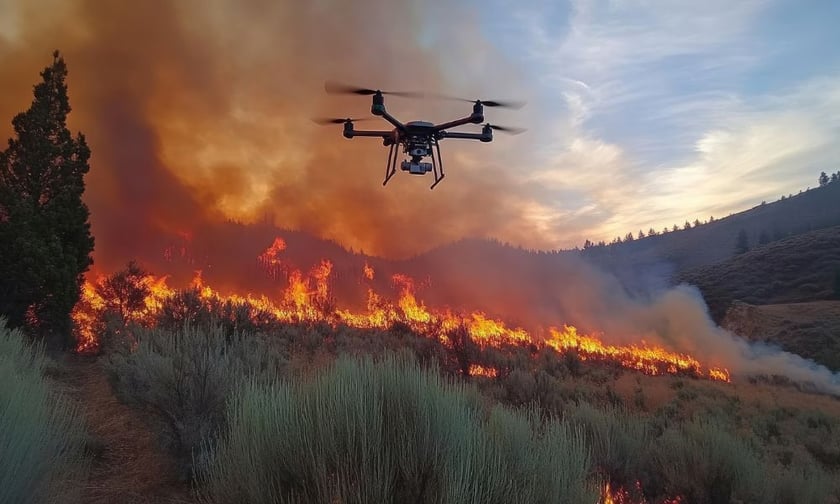
As wildfires become more common in Canada and push insurance claims teams to their limits, technology is playing a critical role in making the response faster, more efficient, and less stressful for all involved. From high-resolution imagery to digital collaboration tools, today’s adjusters have access to innovations that were scarcely imaginable just a few years ago.
According to Greg Smith, president of Crawford & Company (Canada), the tools available to insurance professionals have dramatically improved their ability to assess damage, process claims, and support displaced policyholders – particularly during catastrophe events like this wildfire season.
While the human element remains central to recovery, digital platforms and remote tools are accelerating the claims journey for everyone involved.
Smith pointed out that the role of technology in claims handling has evolved significantly over the past five years – particularly in wildfire scenarios. Recalling the Fort McMurray fires, he said that one of the biggest early challenges was simply understanding which properties had been damaged or destroyed. Because entire communities were often inaccessible for extended periods, adjusters had little visibility, and policyholders were left waiting for weeks to learn the fate of their homes.
Today, things look very different.
“Today, it's quite common for policy holders themselves to be able to check on their properties through video cameras they have installed, or through doorbell cameras and other types of imagery,” Smith told Insurance Business.
In addition, wildfire agencies are releasing more timely and accurate data, including fire zone mapping, allowing adjusters to get a head start on planning and triage.
Smith said this rapid access to information is essential for speeding up every other step of the claims process. Before a claimant even returns home, adjusters may already have a general idea of the damage and a preliminary plan for what’s next.
Technology is also supporting remote collaboration between adjusters and clients. After the initial, often in-person contact during the early weeks of a catastrophe, much of the follow-up – including documentation, communication, and claims updates – can now be handled digitally. Policyholders can upload photos, itemize contents lost in the fire, and track progress using digital platforms without needing to meet face-to-face at every stage.
Even damage estimates have benefited from tech advances. Adjusters, Smith said, can now digitally measure photographs to assess the size of a property, or use tools to help identify lost or damaged contents using customer-supplied images.
“There’s much more information available to our adjusters digitally, and then many more tools that they can use to help the policyholder recover and rebuild after a loss like this,” Smith said.
These technological advances are particularly important during active wildfire events, where entire communities may be under evacuation orders and physical access to loss sites is limited or impossible.
Devin Shillington, vice president of national sales and western Canada operations at Sedgwick, said that virtual workflows and remote estimating tools are helping insurers maintain momentum even when boots on the ground aren't an option.
“Integration with estimating platforms … allows adjusters for remote scope writing using customer or drone data,” he said.
With the help of these systems, insurers can begin processing claims before re-entry is allowed. Desk adjusters, working virtually, can move files forward without needing to visit the property in person – an approach that not only speeds up the process but also minimizes disruptions for evacuated residents.
“Approaches such as these have a positive impact on shortening claim cycles and keeps the claims moving even during evacuations,” Shillington said.
Artificial intelligence is also beginning to make inroads into claims handling, though not yet in the ways that dominate public perception. Rather than replacing adjusters, AI tools are currently being used to streamline backend processes and assist with routine administrative tasks – freeing up human professionals to focus on what matters most.
Smith said that one such tool allows adjusters at Crawford to interact with a large language model to quickly interpret policy language.
He explained that, through a question-and-answer interface, adjusters can input specific coverage-related inquiries – such as whether a certain type of damage is included in a policy – and receive clear responses based on the terms of the document.
Beyond policy interpretation, AI is also helping adjusters craft clear, jargon-free communications with clients. Off-the-shelf AI applications, Smith noted, are increasingly used to draft or refine emails, ensuring messages are easy to understand – especially for policyholders navigating the claims process during a crisis.
While AI is not yet making claims decisions or determining loss amounts, Smith sees a growing role for it as an efficiency booster.
“I think we've got some really good live use cases of AI today. But all of them have ‘a human in the loop’… Even as technology matures, we want to make sure that we are not loosing that human touch, but we do embrace AI as an accelerator,” he said.





