
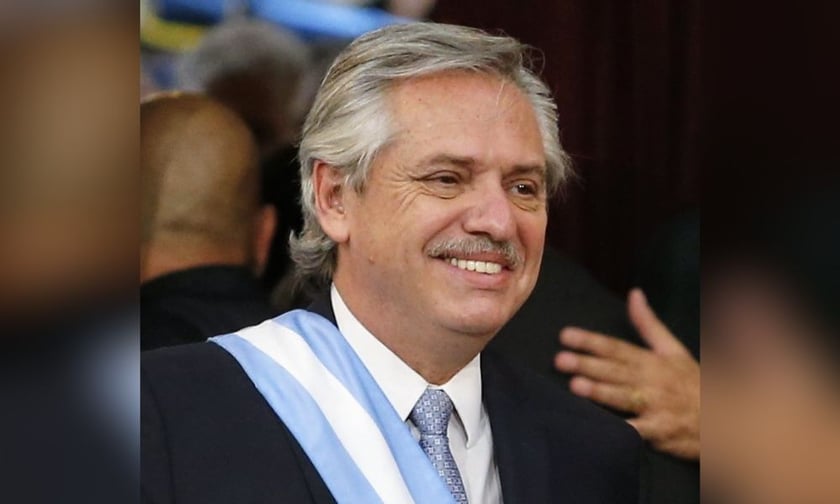
This image is licensed under the Creative Commons Attribution 2.5 Argentina license.
Casa Rosada (Argentina Presidency of the Nation)
The image has been cropped and the background has been blurred.
Alberto Fernández (pictured), Argentina’s former president, has been formally indicted on corruption charges tied to alleged irregularities in the placement of public sector insurance contracts during his time in office. Federal Judge Sebastián Casanello’s decision to move forward with the indictment marks a critical escalation in a growing scandal that has cast a shadow over Fernández’s 2019–2023 administration.
At the heart of the case is the allegation that Fernández used his executive power to benefit close associates, particularly insurance broker Héctor Martínez Sosa - whose wife, María Cantero, served as Fernández’s personal secretary. Prosecutors allege that this favoured relationship led to an outsized concentration of commissions funnelled to Martínez Sosa’s firm through policies contracted with Nación Seguros, the state-run insurer.
In 2021, Fernández issued a presidential decree mandating that all public agencies secure insurance exclusively through Nación Seguros. According to investigators, this directive created fertile ground for a scheme in which intermediaries with personal ties to the president reaped disproportionate financial rewards. Between 2019 and 2023, nearly 60% of all commissions paid by Nación Seguros reportedly went to Martínez Sosa’s firm - equivalent to more than two billion Argentine pesos.
The indictment, which includes charges of “negotiations incompatible with public office,” carries potential penalties of up to six years in prison and a permanent ban from holding government roles. Judge Casanello also ordered the freezing of assets equivalent to approximately US$11 million, citing the scale of the alleged scheme and the former president’s central role in facilitating it. Fernández is accused of billing the broker’s company Héctor Martínez Sosa SA over $4,000,000.
The breadth of the investigation is extensive. In addition to Fernández, more than 30 individuals have been indicted, including Cantero, Martínez Sosa, and Alberto Pagliano, former head of Nación Seguros and reportedly a personal friend of the ex-president. Prosecutors say the alleged scheme involved coordinated efforts across multiple government departments, each obligated by decree to utilize Nación Seguros, with little to no oversight on the commissions being extracted.
Evidence submitted by prosecutors includes a 662-page report from the country’s economic crimes unit, which documents pre-presidency financial relationships between Fernández and Martínez Sosa’s companies. Notably, the final invoice from Fernández to the broker's firm was issued just days before he assumed the presidency, raising questions about a potential conflict of interest that carried over into his term in office.
While Fernández has denied all wrongdoing, asserting that the contracting process complied with administrative norms, Casanello’s ruling pointed to a permissive environment created under the former president’s leadership that enabled private enrichment by individuals closely linked to the executive office.
The indictment follows earlier legal troubles for Fernández, who is separately facing charges related to alleged domestic abuse against his former partner, Fabiola Yáñez. That case gained traction after investigators retrieved communications from a seized mobile device, prompting further scrutiny into both personal and professional conduct during his presidency.
Fernández, 65, did not seek re-election in 2023 and has largely withdrawn from the public spotlight since the transition of power to current President Javier Milei, a self-described anarcho-capitalist whose government has signalled support for pursuing accountability in alleged corruption cases tied to the previous administration.
As the insurance scandal widens, prosecutors have also moved to question eight insurance companies and ordered searches of their offices. The investigation now includes potential money laundering, fraudulent administration, and misuse of public funds.
For Argentina’s public sector insurance market, long criticized for opacity and political interference, the case could serve as a pivotal reckoning. Industry observers warn that the revelations may prompt broader inquiries into state-affiliated insurers and a re-evaluation of policies that concentrate procurement power under political control.
Founded in 1994 as the insurance arm of Banco de la Nación Argentina, Nación Seguros S.A. has grown into one of the country’s most prominent insurance providers, particularly in the public sector. Positioned as a critical pillar in Argentina’s state-owned financial ecosystem, the firm offers a range of products from life and property coverage to liability and auto insurance, often serving government entities and state-run enterprises.
Over the past decade, Nación Seguros has steadily increased its market footprint, consistently ranking among the top five insurers in terms of premium volume. According to Argentina’s insurance regulator, Superintendencia de Seguros de la Nación (SSN), the company posted double-digit annual growth in gross written premiums through much of the 2010s, buoyed by its government contracts and stable policyholder base.
Profitability, however, has varied in recent years. In 2022, amid inflationary pressures and currency volatility, Nación Seguros reported a net profit of approximately ARS 8.5 billion - a solid performance considering broader economic headwinds. The firm benefited from mandated policy placements and investment income tied to sovereign debt instruments.





