
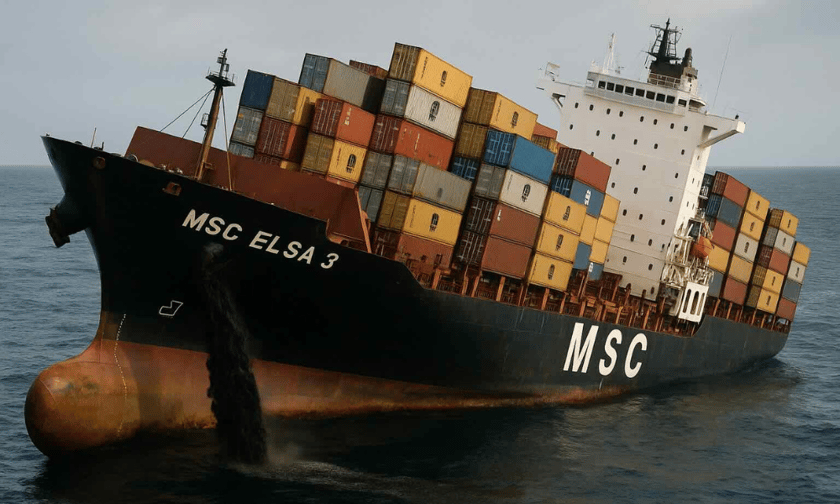
The southern Indian state of Kerala is demanding more than A$1.73 billion in compensation after a Mediterranean Shipping Company (MSC) container vessel sank off its coast, spilling hazardous cargo and plastic pellets that have since blanketed shorelines and disrupted local economies.
The case, now before the Kerala High Court, is fast becoming a major test of global marine insurance arrangements. It has also raised significant concerns about pollution liability, cargo safety declarations, and the growing frequency of high-impact shipping incidents in ecologically sensitive waters.
On 25 May, the Liberian-flagged MSC ELSA 3 developed a list and capsized in the Arabian Sea during its voyage from Vizhinjam to Kochi, just as the southwest monsoon swept into the region. The vessel, which was carrying more than 640 containers, went down about 13 nautical miles from the Alappuzha coast.
Among its cargo were 72 containers filled with plastic nurdles – tiny industrial pellets used to manufacture plastic products – and 13 carrying calcium carbide, a chemical known to react dangerously with water.
Since then, more than 600 tonnes of nurdles have been recovered from coastlines in Kerala, Tamil Nadu and Rameswaram. But state authorities estimate that over 70,000 bags were onboard, and most remain unaccounted for.
The Kerala government has declared the incident a state-specific disaster and filed a civil claim against MSC totalling ₹9,531 crore. That amount includes ₹86.26 billion for ecological harm, ₹3.78 billion for cleanup operations, and ₹5.27 billion to compensate fisherfolk who have lost income due to net damage, fish stock uncertainty, and a collapse in seafood prices.
The insurance architecture for the MSC ELSA 3 follows the conventional structure for large commercial vessels. The ship was covered under Hull and Machinery (H&M) insurance, which applies to total loss or physical damage to the vessel itself. Responsibility for third-party harm – including pollution, wreck removal, and damage to local communities – falls to the vessel’s Protection and Indemnity (P&I) insurer.
That liability is handled by the Steamship Mutual Underwriting Association, a UK-based member of the International Group of P&I Clubs. According to industry sources, the Kerala government is seeking to channel compensation through this liability framework.
Cargo onboard the ship, however, was not covered by MSC. Under maritime law, it is the responsibility of each cargo owner to insure their own goods. Cargo interests impacted by the sinking will need to claim through their own marine insurers. If a General Average is declared, stakeholders may also be required to contribute to recovery costs, depending on the vessel operator’s decisions.
With no attachable assets held in India by MSC, the Kerala High Court has authorised the conditional arrest of two sister ships – MSC Manasa F and MSC Akiteta II – both currently docked at Vizhinjam Port. The arrest orders will remain in force until security for the claim is furnished.
In the meantime, a salvage operation coordinated by the Dutch firm SMIT Salvage is underway. A Dive Support Vessel is expected to arrive on site in early August. Indian authorities report that no further oil sheens have been sighted, but plastic pellets continue to wash ashore, and three containers remain unrecovered at sea.
The Directorate General of Shipping has ordered verification of all cargo declarations and bills of lading amid concerns that some hazardous materials may have been misclassified or inadequately documented.
The case underscores the rising complexity of environmental risk in global shipping. From Australia’s perspective, the MSC ELSA 3 disaster is a stark reminder of how interlinked maritime trade is with local communities and fragile marine environments.
With rising volumes of container traffic through the Indian Ocean and Southeast Asia, the insurance industry may face greater scrutiny around risk concentration, especially when vessels carry undeclared or poorly segregated dangerous goods.
As marine incidents become costlier and more litigious, stakeholders – from insurers and reinsurers to port authorities and policymakers – may need to revisit how cargo risks, environmental exposures, and third-party liabilities are assessed and priced.
For now, Kerala’s shores continue to bear the physical and economic brunt of the incident. As court proceedings advance and salvage work ramps up, marine insurers around the globe are watching closely.
Marine insurers are facing a shift in the nature of risk, with a surge in fires, collisions, and machinery breakdowns pushing up claim costs across the global shipping sector. That’s the key takeaway from new figures released by the Nordic Association of Marine Insurers (Cefor), which found that modern hull claims are being driven by older vessels, mechanical failures and escalating fire incidents. MSC Elsa 3 was 28 years old at the time of the accident.
The group’s latest Ocean and Coastal Hull reports – based on the Nordic Marine Insurance Statistics (NoMIS) database – reveal that fires and collisions now account for the most expensive losses, while machinery damage has become more frequent and costly, particularly on ageing ships built in the post-GFC shipbuilding boom.
Vessels built between 2008 and 2012 – now between 13 and 17 years old – are showing their age. These ships are increasingly affected by main engine and propulsion system issues. According to Cefor, machinery claims accounted for more than half (56 per cent) of all claims costs for ships in this age group in 2024, compared with 35 per cent for newer vessels.
The average machinery claim cost per vessel is now 50 per cent higher than the 2015-2021 average, with 11 such claims exceeding US$5 million reported in 2024 alone. Notably, some of these machinery faults have led directly to more serious incidents, such as blackouts that cause ships to run aground or collide – including the high-profile case of the Dali container ship that struck Baltimore’s Francis Scott Key Bridge in March.
Shipboard fires have become a dominant feature in marine losses in recent years. Between 2016 and 2018, fires causing losses over US$10 million were rare. But from 2019 onwards, the number of serious fire claims has climbed steadily – particularly on container ships where fires often originate in cargo holds.
In 2023, fires accounted for four of the eight losses over US$10 million, including both losses exceeding US$50 million. In 2024, four of the top nine claims were also fire-related. Many of these started in the engine room – again pointing back to machinery as an underlying issue.
Cefor analysts warn that while fire claims are typically classified separately, they often originate from engine failure or other mechanical issues, indicating that machinery may be the hidden link behind a growing share of high-value losses.
Alongside machinery and fire claims, collisions have returned to the forefront of insurer concerns. After a relatively quiet decade, 2024 saw the two most expensive claims over US$30 million both caused by vessel collisions. The cost of claims involving groundings and contacts has also risen.
At the same time, weather-related incidents have picked up, particularly since late 2023. Rerouting around the Cape of Good Hope – a tactic used by ships avoiding the Red Sea due to regional tensions – has increased exposure to rougher seas, which can exacerbate the risk of engine blackouts or hull damage.
Another finding in the Cefor report points to lasting effects from the COVID-19 pandemic. Ships that were laid up in 2020 were found to have worse claims histories both before and after the idle period. Some have since been scrapped, but others remain in service with heightened risk profiles. The data suggests that vessels withdrawn from service early were also those most prone to problems – a phenomenon Cefor refers to as a form of “survival of the fittest.”
Although the inflationary spike in claims costs seen in 2022 has eased slightly, marine insurers are still contending with expensive repairs, salvage efforts, and delays in spare parts. The true cost of a machinery failure, the report notes, often goes beyond the part itself. Blackouts, steering failures and engine breakdowns can result in secondary events such as fires or collisions – inflating the final loss substantially.
What’s clear is that marine risks are no longer confined to single causes. Today’s claims are increasingly multi-layered – with weather, machinery, routing decisions and cargo hazards combining to create complex and costly scenarios.
For Australian underwriters with exposure to international shipping lanes, the Cefor data offers a clear warning: risk is rising, particularly on older vessels, and the line between technical failure and catastrophic loss is thinner than ever.
2. Francis Scott Key Bridge Collapse, Baltimore (2024)
3. Costa Concordia Cruise Ship Disaster (2012)
4. Prestige Oil Spill (2002)
5. MOL Comfort Sinking (2013)
6. ONE Apus Container Loss (2020)
7. Felicity Ace Fire and Sinking (2022)
8. MV Wakashio Oil Spill (2020)



